
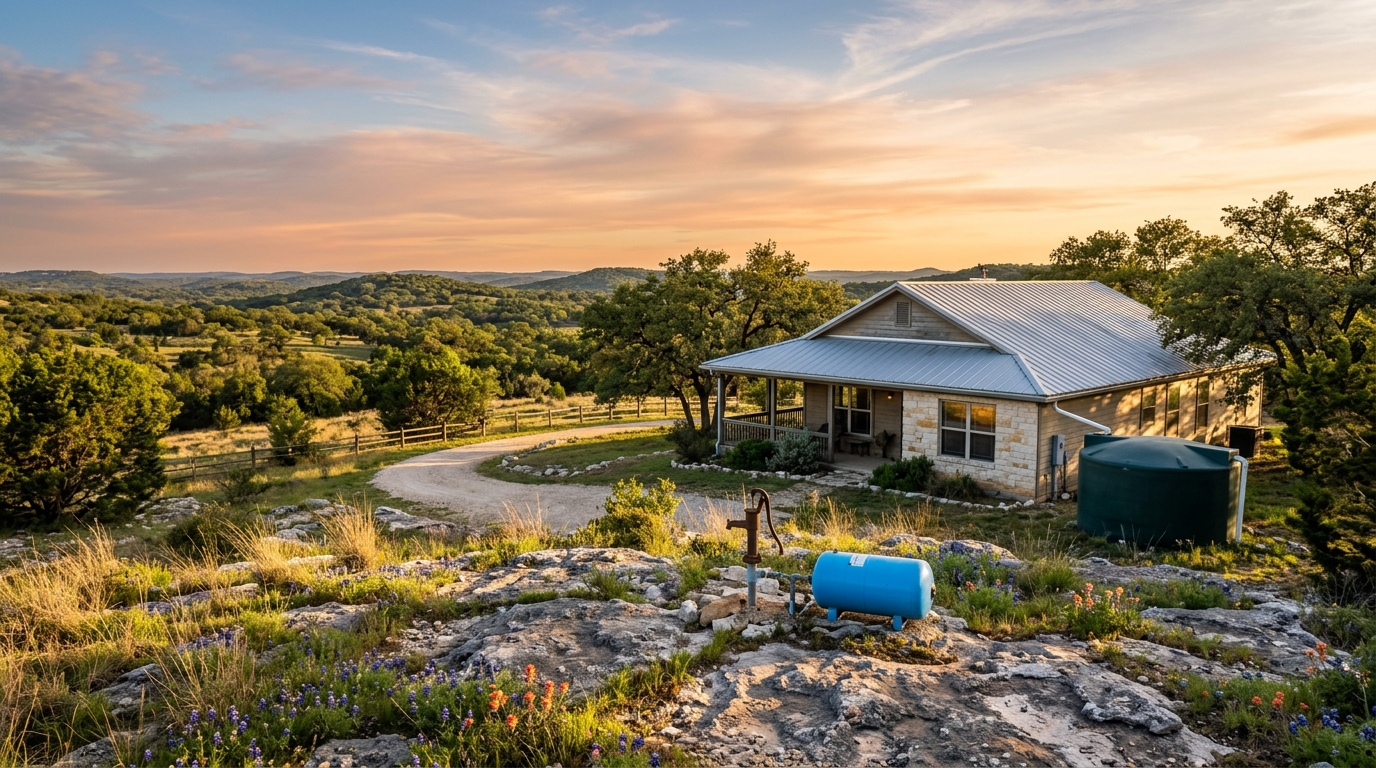
Buyers ask me about square footage and finish-out before they ask a single question about the water coming out of the tap or where the toilet flushes to. That's backwards.
If you're buying rural in the Hill Country, the three systems that will actually run your monthly life are septic, well, and rainwater. Not the kitchen. Not the primary suite. Those three. And most agents will hand you a survey, point at a well head, and say "yep, there's a well" like that's the end of the conversation.
It's not the end of the conversation. It's the whole conversation.
Start with the well, because that's where the money hides. A complete residential water well system in the Hill Country runs $10,000 to $25,000 or more in 2026, per WellDrillingCosts.com, and the reason is 200 to 600 feet of Edwards Plateau limestone between you and the Trinity Aquifer. That's not soft dirt. That's rock that eats bits. I've watched drillers pull off a property at 380 feet because the water table dropped on the neighbor's new well and they had to go deeper mid-job. The quote went up. It always goes up.
Here's the part nobody explains at closing: Texas runs on the Rule of Capture for groundwater. Your neighbor can drill a deeper, higher-yield well 300 feet from your property line, pull the aquifer down, and you have zero legal remedy. None. Your options are drill deeper on your own dime or haul water. That's it. So when a listing says "private well" and you don't have a recent flow test, a static water level, and a bacteria panel, you're buying a mystery.
Call TR Drilling out of Boerne before you close. Four decades in this region, they'll give you a written quote, and they show up same-day on emergencies. Pay for the flow test. It's the cheapest insurance you'll ever buy on a rural property.
The water itself is a whole other line item. Hill Country well water tends to run hard — calcium and magnesium off the charts — plus iron, manganese, and enough hydrogen sulfide in some pockets to make your guest bathroom smell like rotten eggs at 6am. A softener plus a whole-house filtration setup is another $4,000 to $8,000 installed depending on what your test comes back with. Nobody tells you this at the showing.
Now septic. Hays County requires a permit for every OSSF regardless of lot size. Travis County permits run $285 to $700. If you're in an aquifer zone — and a lot of this region is — you're on an aerobic system whether you like it or not, and aerobic systems cost $10,000 to $20,000 to install and require a mandatory two-year maintenance contract with inspections every four months. That's $150 to $500 a year forever. Not for the first two years. Forever. If you let the contract lapse, the county can flag your property, and good luck at resale.
The undervalued play here — and I don't see enough buyers running this math — is properties with existing, well-maintained conventional (non-aerobic) septic systems in areas where they're still permitted. Lower install cost was already absorbed by the seller, and the ongoing maintenance is dramatically cheaper. If you find one, get the pump-out and inspection records before you write the offer. If the seller can't produce them, price that risk in.
Rainwater is the one people skip and shouldn't
Rainwater catchment is treated like a granola-crunchy add-on out here and it shouldn't be. If your well runs 3 gallons a minute on a good day — which is not unusual on the harder limestone shelves — a 20,000 to 30,000 gallon rainwater system is not a hobby. It's redundancy. It's the difference between hosting your family for Thanksgiving and asking them to not flush.
A proper catchment system with tanks, first-flush diverters, filtration, and UV sterilization runs $15,000 to $40,000 depending on size and whether you're doing potable or just irrigation and toilet supply. That sounds like a lot until you price a second well when the first one goes low. Then it sounds like a bargain.
I've got clients up near Wimberley — not far from Jacob's Well Natural Area, where swimming is currently suspended because the spring's flow has dropped — who run entirely off catchment for household use and only use the well for landscape. Their monthly water cost is functionally zero. Their neighbors are hauling water at $200 a load. That contrast is going to get sharper, not softer, over the next ten years.
The rural land number backs this up. Texas Real Estate Research Center's Q1 2026 Rural Land Report has the Austin-Waco-Hill Country region at $8,028 per acre, up 8.27% year-over-year. Land keeps climbing. What's on the land — the well, the septic, the water strategy — is what makes it livable. And that gap between raw dirt and livable dirt is where most buyers get their first real lesson in what Hill Country actually costs.
The practical order of operations if you're under contract on a rural property right now: get the well tested (flow, static level, bacteria, hardness, iron, sulfide) before option period ends. Pull the septic permit history from the county. Ask the seller for the last three maintenance reports if it's aerobic. Walk the property and figure out where a rainwater system could sit — roof pitch, tank pad, gutter runs. If any of that comes back ugly, you renegotiate or you walk. That's the whole game.
The house is the easy part. The rural property outside town is not the house. It's the three systems. Get those right and you can build or buy anything on top of them. Get them wrong and the prettiest kitchen in Bulverde won't save you.
Ask about the systems before you ask about the countertops. Every single time.
Data sourced from WellDrillingCosts.com (2026 Hill Country well drilling), Texas Real Estate Research Center Q1 2026 Rural Land Report, and Hays/Travis County OSSF permit schedules. Verify current numbers with a local agent before acting.


Leave a Comment